

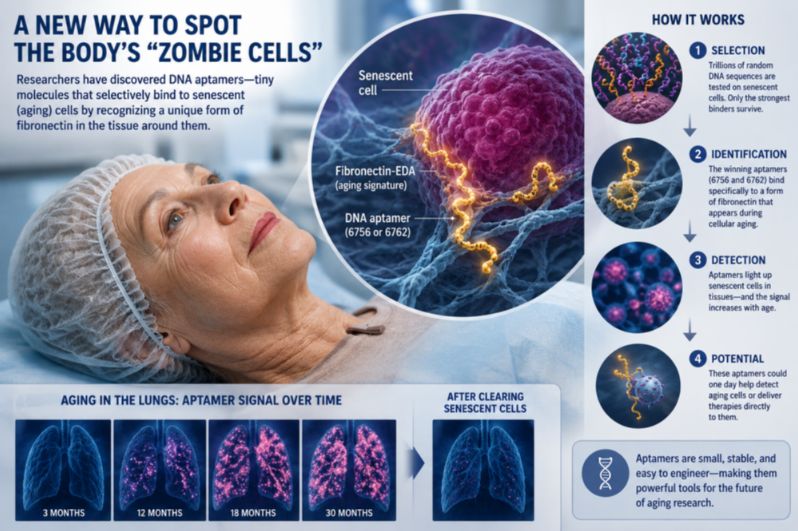
For decades, scientists have searched for a reliable way to identify one of the most mysterious, and increasingly important, features of aging: senescent cells. These cells are sometimes called “zombie cells” because they occupy a strange biological middle ground. They are not dead, yet they no longer function normally. Instead of dividing and helping repair tissues, they linger in the body, secreting inflammatory chemicals that can damage nearby cells and alter entire organs over time.
Senescent cells have been linked to arthritis, fibrosis, cardiovascular disease, diabetes, neurodegeneration, and frailty. Some researchers now suspect they are among the central engines of biological aging itself. But there has been a persistent problem. Scientists have struggled to identify these cells cleanly and consistently. No universal marker exists. Detecting senescent cells often requires combining multiple laboratory signals, many of which overlap with ordinary stress responses. Now, a study published in Aging Cell may offer an unexpected solution: evolve entirely new molecular tools capable of recognizing aging cells directly.
Evolving Molecules to Hunt Aging Cells
The researchers did not begin with a known target. Instead, they allowed biology itself to guide the search. Using a technique called SELEX, short for Systematic Evolution of Ligands by EXponential enrichment, the team generated trillions of random DNA sequences and exposed them to senescent mouse cells. Sequences that attached to healthy cells were discarded. Those that preferentially recognized senescent cells survived to the next round.
The process resembles accelerated evolution in a test tube. After repeated rounds of selection, the scientists isolated a handful of promising molecules known as DNA aptamers. Aptamers are often described as chemical cousins of antibodies. Like antibodies, they can recognize highly specific biological targets. But aptamers are smaller, easier to engineer, and sometimes better able to penetrate tissues.
Among the strongest candidates were two aptamers known as 6756 and 6762. Both consistently attached to senescent cells across multiple mouse tissues and across several different forms of cellular stress, including radiation exposure, oxidative damage, and chemotherapy-like injury. That consistency suggested the molecules were detecting something fundamental about senescence itself.
Aging Leaves Scars Outside the Cell
The study’s most intriguing finding emerged when researchers identified what the aptamers were binding to.Surprisingly, the target was not a classic intracellular aging protein. Instead, the aptamers recognized a specialized form of fibronectin, a structural protein that helps form the extracellular matrix, the scaffolding surrounding cells. More specifically, the aptamers appeared to bind a variant called fibronectin-EDA, which becomes enriched around senescent cells.
The discovery hints at a broader concept in aging biology: senescent cells may not merely malfunction internally. They may actively remodel the tissue environment around them.In effect, aging cells appear to leave molecular footprints in the extracellular matrix itself.
Conventional antibodies did not fully recognize the same structures detected by the aptamers, suggesting these DNA molecules may be sensing subtle changes in protein shape or chemical modification associated specifically with aging tissues. That distinction could prove important. Aging is increasingly understood not simply as cellular decline, but as a gradual transformation of entire tissue ecosystems.
The Lungs of Old Mice Told the Story
To determine whether the aptamers worked in living tissue rather than just cell culture, researchers examined mouse lungs across different ages. Young mice showed almost no staining. Older mice, however, displayed progressively stronger signals as they aged. By late life, the aging-associated patterns were strikingly visible.
The researchers then used genetically engineered mice in which senescent cells could be selectively eliminated. Once those cells were cleared, aptamer staining dropped significantly. The findings suggest the aptamers are closely linked to the biological presence of senescence, not merely incidental tissue damage.
Interestingly, the staining extended beyond the actual number of senescent cells themselves. The researchers speculate that the aptamers may also detect lingering extracellular “residue” left behind after senescent cells remodel surrounding tissues. That idea echoes an emerging theme in aging research: inflammation and tissue dysfunction may persist long after the original cellular injury occurs.
Toward Precision Anti-Aging Therapies
The discovery arrives during a period of intense interest in senolytics, experimental drugs designed to selectively remove senescent cells. In animal studies, clearing senescent cells has produced remarkable effects, including improved physical function, reduced inflammation, delayed tissue degeneration, and extended healthy lifespan. Human trials remain early, but enthusiasm in the field has grown rapidly.
One of the greatest obstacles, however, is precision. Senescent cells can resemble normal stressed cells, making targeted therapy difficult. That is where aptamers could become transformative. Because aptamers can be engineered to carry drugs, imaging tracers, or nanoparticles, future versions might function like molecular delivery systems, guiding therapies directly to aging cells while sparing healthy tissue.
In theory, such tools could one day allow physicians not only to measure biological aging but also to intervene with far greater specificity.
Aging as a Biological Process, Not Just the Passage of Time
Perhaps the deepest implication of the study is philosophical as much as medical. For much of modern history, aging was treated as inevitable wear and tear, a passive decline beyond intervention. But modern biology increasingly views aging as an active, measurable process driven by identifiable molecular mechanisms.
Senescent cells are becoming central characters in that story. The newly discovered aptamers are not yet ready for clinical use. Notably, they worked far better in mice than in human cells, underscoring how much remains unknown about human senescence biology. Still, the work demonstrates that entirely new markers of aging can be discovered without knowing beforehand what scientists are looking for.
That shift may prove crucial. Biology often hides its most important signals in places researchers were not originally trained to search. And in the case of aging, the body may have been leaving clues in its surrounding cellular landscape all along.
Reference
1. Pearson KS, Jachim SK, Doherty CD, et al. An Unbiased Cell-Culture Selection Yields DNA Aptamers as Novel Senescent Cell-Specific Reagents. Aging Cell. 2025;24(11):e70245. doi:10.1111/acel.70245
2. Baker DJ, Wijshake T, Tchkonia T, et al. Clearance of p16Ink4a-positive senescent cells delays ageing-associated disorders. Nature. 2011;479(7372):232-236. Published 2011 Nov 2. doi:10.1038/nature10600
3. Kirkland JL, Tchkonia T. Senolytic drugs: from discovery to translation. J Intern Med. 2020;288(5):518-536. doi:10.1111/joim.13141
4. López-Otín C, Blasco MA, Partridge L, Serrano M, Kroemer G. The hallmarks of aging. Cell. 2013;153(6):1194-1217. doi:10.1016/j.cell.2013.05.039
5. Childs BG, Durik M, Baker DJ, van Deursen JM. Cellular senescence in aging and age-related disease: from mechanisms to therapy. Nat Med. 2015;21(12):1424-1435. doi:10.1038/nm.4000
