

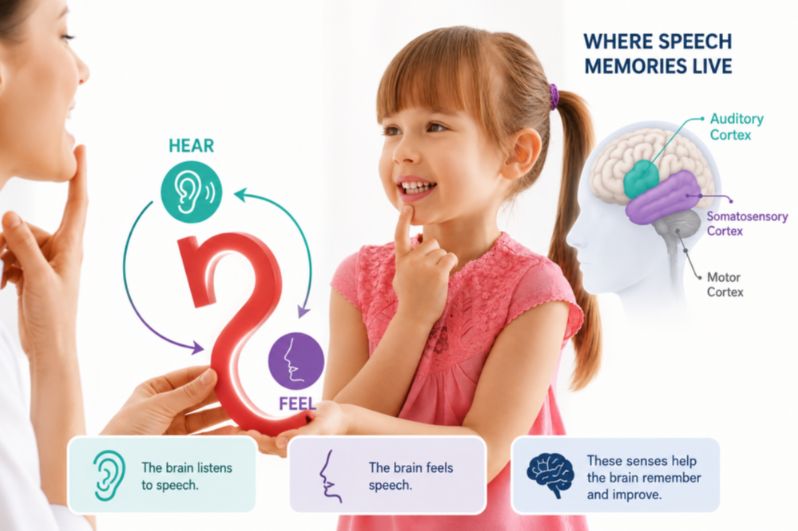
Speech feels effortless. A thought forms, the mouth moves, and words appear. But behind every sentence is a remarkable act of neural prediction. The brain must decide where to place the tongue, how widely to open the jaw, how tightly to shape the lips and how much air to release, all within fractions of a second.
A Tiny Trick of the Ear
In the study, healthy young adults were asked to read simple made-up words such as “bep,” “gep” and “dep.” As they spoke, they heard their own voices through headphones. But the researchers quietly altered one feature of the sound, shifting part of the vowel upward.
The speakers did what human brains are built to do: they adjusted. Without conscious effort, they changed their pronunciation to compensate for the distorted feedback. Their brains learned a new speech pattern.
Then came the critical test. After the learning task, researchers used a noninvasive magnetic stimulation technique to briefly disrupt one of three brain regions: the auditory cortex, which processes sound; the somatosensory cortex, which tracks the feel of the tongue, lips and mouth; or the primary motor cortex, which helps drive movement.
The next day, the participants returned.
The Memory Was in the Senses
The result was striking. People whose auditory cortex or somatosensory cortex had been disrupted lost much of the speech learning they had gained the day before. But those whose primary motor cortex had been disrupted remembered the new speech pattern about as well as people who received no brain stimulation.
That does not mean the motor cortex is unimportant for speech. We still need motor regions to move the mouth and voice box. But the study suggests that the memory of a newly learned speech pattern depends heavily on sensory cortex.
The brain may not simply memorize a set of muscle commands. Instead, it may remember what successful speech should sound like and feel like. From that sensory blueprint, it can rebuild the movements needed to speak.
Speech Is a Loop, Not a Command
This finding fits a broader idea in neuroscience: movement is not a one-way command from brain to muscle. It is a loop. When we speak, we hear our own voice. We feel the position of the tongue, jaw and lips. The brain compares those signals with the sound and sensation it expected. If the match is off, the system corrects course.
This feedback loop is why people adjust their speech after getting braces, losing hearing, learning a new accent or recovering from a neurological injury. Speech is constantly being recalibrated.
The new study shows that these sensory systems do more than detect errors. They help preserve the correction.
Why This Matters for Therapy
The findings could reshape how scientists think about speech rehabilitation. Many therapies emphasize repeated practice of movements. Practice remains essential, but the study suggests that strengthening sensory feedback may be just as important for making improvement last.
For patients recovering from stroke, traumatic brain injury, hearing loss or speech disorders, therapy may need to focus not only on how the mouth moves but also on how speech sounds and feels.
A person relearning speech may be rebuilding a sensory map as much as a motor program.
The Quiet Intelligence of Sensation
The study offers a humbling lesson about the brain. Speech may look like movement, but its memory is deeply sensory. Every fluent sentence depends on an internal record of sound and touch: the expected ring of a vowel, the feel of the tongue against the palate, the subtle shape of the mouth before a word leaves the lips.
To speak, the brain does not merely command the body. It listens to it.
Reference
1. Rao N, Gendron R, Manning TF, Ostry DJ. Sensory basis of speech motor learning and memory. Proc Natl Acad Sci U S A. 2026;123(17):e2525468123. doi:10.1073/pnas.2525468123
2. Houde JF, Jordan MI. Sensorimotor adaptation in speech production. Science. 1998;279(5354):1213-1216. doi:10.1126/science.279.5354.1213
3. Tremblay S, Shiller DM, Ostry DJ. Somatosensory basis of speech production. Nature. 2003;423(6942):866-869. doi:10.1038/nature01710
4. Tourville JA, Guenther FH. The DIVA model: A neural theory of speech acquisition and production. Lang Cogn Process. 2011;26(7):952-981. doi:10.1080/01690960903498424
5. Nasir SM, Ostry DJ. Auditory plasticity and speech motor learning. Proc Natl Acad Sci U S A. 2009;106(48):20470-20475. doi:10.1073/pnas.0907032106
