

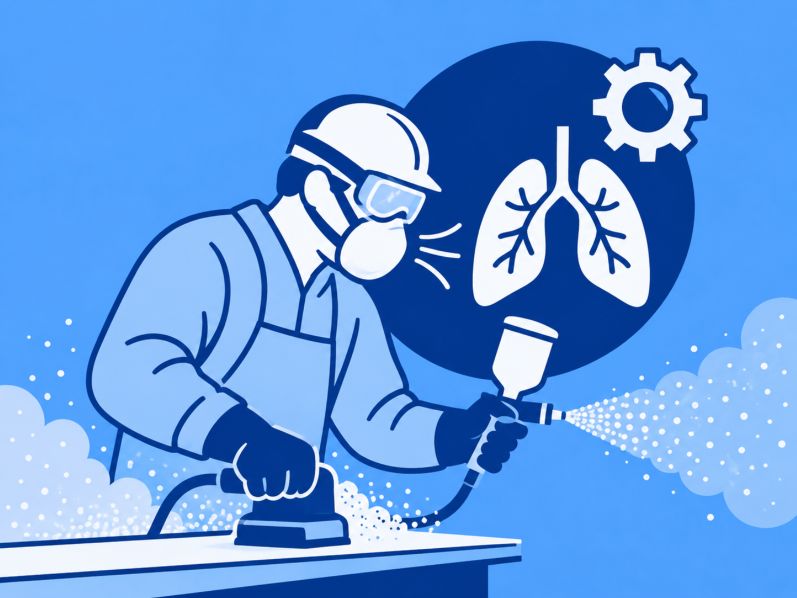
For workers whose asthma is linked to flour dust, animal proteins, chemicals or other occupational exposures, identifying and avoiding the trigger can seem like the key to recovery. But a long-term Finnish study suggests that removing the workplace exposure does not necessarily make the asthma disappear.
More than eight years after patients were evaluated for suspected work-related asthma, complete remission was rare and nearly one-third had difficult-to-treat disease. Long-term respiratory outcomes were also broadly similar whether occupational asthma had been confirmed by a specific inhalation challenge or the test had been negative.
The findings suggest that the future course of work-related asthma may depend less on the diagnostic label itself and more on how severe and poorly controlled the disease has already become by the time it is recognized.
When the Workplace Becomes an Asthma Trigger
Severity at Diagnosis May Matter More Than the Test Result
One of the most important findings was that a positive inhalation challenge did not strongly predict who would have severe asthma years later. Baseline disease severity did.
Patients who already had difficult-to-treat asthma at their original evaluation had more than five times the odds of having difficult-to-treat disease at follow-up. Those needing GINA step 4 or 5 treatment had roughly three times the odds. Poor asthma control and older age were also associated with worse long-term outcomes.
This raises an important possibility: once airway inflammation becomes persistent, removing the initial trigger may prevent further exposure without fully reversing the disease already established in the lungs.
Asthma is more than a temporary reaction to something inhaled. Repeated inflammation can increase airway sensitivity and may contribute to longer-lasting changes in airway function. The study cannot prove which biological mechanisms account for persistent disease, but it suggests that the condition of the airways at diagnosis may offer an important clue about what happens years later.
Avoiding the Trigger Can Come at a Social Cost
Occupational asthma can also affect far more than breathing. Patients with positive challenge tests were more likely to change occupations and more likely to experience unemployment after their symptoms began.
About 67 percent of the SIC-positive group had changed occupations, compared with 47 percent of those with negative tests. Unemployment was reported by 46 percent of the positive group and 29 percent of the negative group.
Three-quarters of working-age participants remained in the workforce, but about 40 percent of those still working rated their work ability as only poor or moderate.
The dilemma is difficult. Leaving the triggering environment may protect the lungs, but it can also threaten income, professional identity and financial stability.
The Burden Extends Beyond the Lungs
Work-related asthma was also accompanied by a substantial broader health burden. About two-thirds of participants continued to report rhinitis, and 60 percent had at least two other medical conditions.
Symptoms of depression were reported by roughly one-third of participants, while about one-quarter reported anxiety symptoms. Difficult-to-treat asthma at follow-up was associated with depression, anxiety and lower income, although these associations do not establish cause and effect.
The findings support a broader approach to care in which asthma control, occupational exposure, mental health, comorbid disease and work ability are considered together.
The Earliest Window May Be the Most Important
The study does not reduce the importance of identifying the occupational cause of asthma. Knowing what triggered the disease can be essential for preventing continued exposure and making decisions about workplace accommodations or career changes.
But identifying the trigger and predicting recovery are two different questions.
The strongest warning signs for persistent asthma were already present when patients were first evaluated: poor asthma control, difficult-to-treat disease and the need for intensive therapy.
The study has limitations, including a follow-up response rate of only 44 percent and its focus on patients treated within a specialized Finnish occupational-health system. Its findings therefore may not apply equally to every workforce or health-care setting.
Still, the central message is difficult to ignore. The workplace exposure that starts or worsens asthma may eventually be removed, but the airway disease it helped create can persist for years.
That makes early recognition especially important. For a worker whose asthma repeatedly worsens on the job or improves away from work, identifying the connection, controlling airway inflammation and reducing harmful exposure may be most valuable before the disease becomes difficult to reverse.
Reference
1. Suojalehto H, Lantto J, Kailari O, Vanhatalo J, Jämsänen T, Joensuu J, Toivio P, Lindström I. Long-term prognosis of work-related asthma after specific inhalation challenge. J Allergy Clin Immunol Pract. 2026 Aug 27:S2213-2198(26)00711-7. doi: 10.1016/j.jaip.2026.08.025. Epub ahead of print. PMID: 42660225.
2. Vandenplas O, Suojalehto H, Aasen TB, Baur X, Burge PS, de Blay F, Fishwick D, Hoyle J, Maestrelli P, Muñoz X, Moscato G, Sastre J, Sigsgaard T, Suuronen K, Walusiak-Skorupa J, Cullinan P; ERS Task Force on Specific Inhalation Challenges with Occupational Agents. Specific inhalation challenge in the diagnosis of occupational asthma: consensus statement. Eur Respir J. 2014 Jun;43(6):1573-87. doi: 10.1183/09031936.00180313. Epub 2014 Mar 6. PMID: 24603815.
3. Torén K, Blanc PD. Asthma caused by occupational exposures is common - a systematic analysis of estimates of the population-attributable fraction. BMC Pulm Med. 2009;9:7. Published 2009 Jan 29. doi:10.1186/1471-2466-9-7
4. Rachiotis G, Savani R, Brant A, MacNeill SJ, Newman Taylor A, Cullinan P. Outcome of occupational asthma after cessation of exposure: a systematic review. Thorax. 2007 Feb;62(2):147-52. doi: 10.1136/thx.2006.061952. Epub 2006 Oct 13. PMID: 17040933; PMCID: PMC2111252.
5. Henneberger PK, Patel JR, de Groene GJ, et al. The effectiveness of removal from exposure and reduction of exposure for managing occupational asthma: Summary of an updated Cochrane systematic review. Am J Ind Med. 2021;64(3):165-169. doi:10.1002/ajim.23208
