

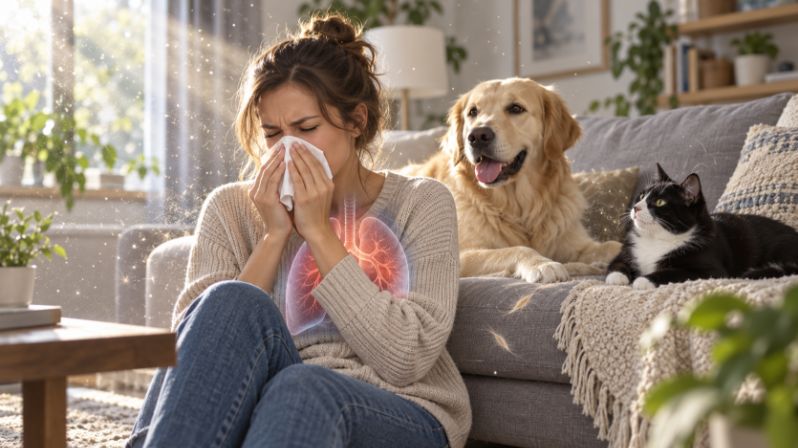
For millions of households, cats and dogs are part of the family. But for people with asthma or allergies, a deceptively simple question remains difficult to answer: Does living with a pet damage respiratory health, or can early exposure sometimes protect against allergic disease?
Owning a Pet Is Not the Same as Being Allergic to It
Pet allergens are proteins carried on microscopic particles from skin, saliva and other secretions. They can remain suspended in indoor air, collect in carpets and furniture, and travel from one building to another on clothing. As a result, measurable cat and dog allergens can be found even in homes without animals. In national housing studies, proposed concentrations associated with asthma symptoms in sensitized people have historically been around 8 micrograms per gram of dust for the major cat allergen Fel d 1 and 10 micrograms per gram for the dog allergen Can f 1, although these values should be viewed as research thresholds rather than universal biological cutoffs.
This distinction becomes particularly important in asthma. In a U.S. National Health and Nutrition Examination Survey analysis, more than half of households reported a cat or dog, while approximately 12 percent of participants were sensitized to each animal. Among people who already had asthma and were sensitized to a particular pet, high bedroom exposure to that animal's allergen was associated with substantially greater asthma morbidity.
For dog-sensitized people with asthma, investigators estimated that 44.2 percent of asthma attacks occurring in the highly exposed group were attributable statistically to elevated bedroom dog allergen, corresponding to roughly 1.16 million excess attacks in the U.S. population represented by the study. Among cat-sensitized people, the corresponding estimate was 30.3 percent, or approximately 549,000 excess attacks. The study also estimated roughly 349,000 excess emergency or urgent-care visits associated with dog exposure and 352,000 associated with cat exposure among sensitized people with asthma. Because these were population estimates derived from observational data, they should not be interpreted as proof that every exposure caused an individual attack. Nevertheless, they emphasize an important pattern: sensitization combined with continuing exposure appears considerably more consequential than pet ownership by itself.
Cats, Asthma and the Limits of Association
A smaller adult study from Brazil illustrates why pet research can be difficult to interpret. Researchers studied 316 university students and employees, including 51 cat owners, 140 dog owners and 125 people without pets. Participants underwent allergy testing, spirometry and a bronchial challenge test rather than relying solely on questionnaires. Cat owners were more likely to meet the study's definition of confirmed asthma, with an adjusted relative risk of 3.24 compared with people without pets. Atopy was also strongly associated with asthma in the analysis.
That result is intriguing, but it does not demonstrate that acquiring a cat causes asthma. The study was cross-sectional, relatively small and unable to establish which came first, the pet, sensitization or asthma. Larger studies following children over time have produced a much less clear picture.
A 2022 analysis combining more than 77,000 children from nine European birth cohorts found no overall association between early-life cat ownership and school-age asthma and no clear overall association for dog ownership either. What stood out instead was sensitization. Children sensitized specifically to cats or dogs had much higher odds of asthma, and there was evidence suggesting that continued ownership could amplify risk among those already sensitized.
The emerging picture therefore differs from a simple message that cats "cause asthma." Susceptibility appears to depend on the interaction between a person's immune system and the exposure occurring around that person.
Why Dogs Raise a Different Question
In the same Brazilian adult study, dog ownership was not significantly associated with greater asthma prevalence. Instead, dog owners had slightly lower average spirometry measurements. After adjustment, FEV1, the amount of air forcefully exhaled during the first second, was about 3.5 percentage points lower than predicted, while forced vital capacity was about 3.6 percentage points lower compared with people without pets. The average values remained within broadly normal ranges.
The researchers proposed that increased exposure to bacterial products such as endotoxin in homes with dogs might contribute to airway inflammation. That mechanism, however, was not measured in the study and remains a hypothesis rather than an established explanation.
This distinction matters. A small statistical difference in lung function among otherwise healthy adults should not be interpreted to mean that dogs damage the lungs of everyone who owns one. It does raise a question worthy of further study, particularly in people who already have compromised respiratory reserve.
The “Protective Pet” Paradox
Some studies have produced an even more surprising result: children currently living with pets sometimes appear to have less allergy than children without them.
An influential study of nearly 3,000 schoolchildren found lower rates of sensitization to cat and dog allergens among current pet owners, along with less hay fever and rhinitis. Yet children whose families had owned pets in the past, but no longer did, were more likely to have asthma. The investigators concluded that much of the apparent protection could be explained by selective avoidance.
The logic is straightforward. When a child begins wheezing or develops obvious animal allergy, a family may remove its cat or dog or decide not to acquire another one. Years later, a cross-sectional survey places that child in the "no current pet" group. Meanwhile, families whose children remain symptom-free continue keeping animals. Pet owners can therefore appear healthier even when pet exposure itself was not responsible for making them healthy.
This phenomenon has sometimes been called a "healthy pet owner effect," and it illustrates one of the central problems of observational allergy research: people choose their environments partly in response to their health.
Does Exposure in Infancy Train the Immune System?
The possibility that early microbial and animal exposure might shape immune development has attracted considerable attention. In the Dutch schoolchildren study, pet exposure during the first two years of life was associated with somewhat less sensitization to outdoor pollens later in childhood, but it was not consistently associated with less asthma or reduced bronchial hyperresponsiveness.
More recent cohort data reinforce that uncertainty. In the European analysis of more than 77,000 children, neither early cat nor dog ownership produced a clear overall reduction in school-age asthma. Cat and dog ownership also were not significantly associated with development of pet-specific sensitization overall. In contrast, once pet-specific sensitization was present, its association with asthma was strong.
This makes it difficult to justify obtaining a pet specifically in an effort to prevent asthma or allergies. Early exposure may influence immune development in some circumstances, but the direction and magnitude of that effect appear to depend on genetics, microbial exposures, the particular animal, the home environment and the child's developing immune system.
For Asthma, the Bedroom May Matter More Than the Pet Ownership Box
For someone who already has asthma, the clinically useful question is often not, "Do you own a pet?" but rather, "Are you sensitized to it, are you exposed to it, and do your symptoms worsen around it?"
That approach is reflected in U.S. asthma guidelines. The National Asthma Education and Prevention Program does not recommend routine indoor-allergen interventions for every person with asthma. Instead, targeted mitigation is conditionally recommended when a person is exposed to an indoor allergen and either has documented sensitization or develops symptoms related to that exposure. Multicomponent strategies are generally favored over reliance on a single measure such as an air purifier alone.
Pet removal is especially complicated, emotionally as well as scientifically. Controlled evidence demonstrating how much removal improves asthma is limited, and pet allergens can persist in a home after an animal is gone. The guidelines therefore emphasize individualized decisions. When symptoms clearly worsen around a pet, options can include keeping the animal out of the bedroom and heavily used rooms, reducing reservoirs of allergen, improving cleaning and filtration, and discussing whether removal is necessary when asthma remains poorly controlled.
The Pet Is Only Half of the Story
The conflicting research on cats, dogs and asthma becomes less contradictory once the immune system is brought into the picture. A cat or dog may represent a relatively harmless exposure for one person and an important source of airway inflammation for another.
Current evidence does not support the idea that pet ownership universally causes asthma, nor does it establish that pets reliably protect children against developing allergic disease. Instead, allergic sensitization appears to be one of the key dividing lines. Among people who are sensitized and have asthma, continuing high exposure can be associated with substantially more attacks and emergency care. Among people who are not sensitized, the consequences of pet ownership are far less predictable.
For families deciding whether a pet belongs in a home with asthma, the most informative clues therefore come from the individual, symptoms after exposure, allergy testing when appropriate, asthma control and the amount of allergen present in the living environment.
In respiratory disease, the question may ultimately be less about whether cats or dogs are inherently "good" or "bad" and more about which immune system is sharing the house with them.
Reference
1. Gergen PJ, Mitchell HE, Calatroni A, et al. Sensitization and Exposure to Pets: The Effect on Asthma Morbidity in the US Population. J Allergy Clin Immunol Pract. 2018;6(1):101-107.e2. doi:10.1016/j.jaip.2017.05.019
2. Luczynska CM, Li Y, Chapman MD, Platts-Mills TA. Airborne concentrations and particle size distribution of allergen derived from domestic cats (Felis domesticus). Measurements using cascade impactor, liquid impinger, and a two-site monoclonal antibody assay for Fel d I. Am Rev Respir Dis. 1990;141(2):361-367. doi:10.1164/ajrccm/141.2.361
3. Custovic A, Green R, Fletcher A, et al. Aerodynamic properties of the major dog allergen Can f 1: distribution in homes, concentration, and particle size of allergen in the air. Am J Respir Crit Care Med. 1997;155(1):94-98. doi:10.1164/ajrccm.155.1.9001295.
4. Pinot de Moira A, Strandberg-Larsen K, Bishop T, et al. Associations of early-life pet ownership with asthma and allergic sensitization: A meta-analysis of more than 77,000 children from the EU Child Cohort Network. J Allergy Clin Immunol. 2022;150(1):82-92. doi:10.1016/j.jaci.2022.01.023
5. Aghapour M, Ubags ND, Bruder D, et al. Role of air pollutants in airway epithelial barrier dysfunction in asthma and COPD. Eur Respir Rev. 2022;31(163):210112. Published 2022 Mar 23. doi:10.1183/16000617.0112-2021
